23 Home Office Ideas That Feel Calm, Focused, and Effortlessly Stylish
This post contains affiliate links. As an Amazon Associate, I earn from qualifying purchases at no additional cost to you. I only curate products that align with the Comfylish aesthetic.
23 Home Office Ideas to Transform Your Productivity
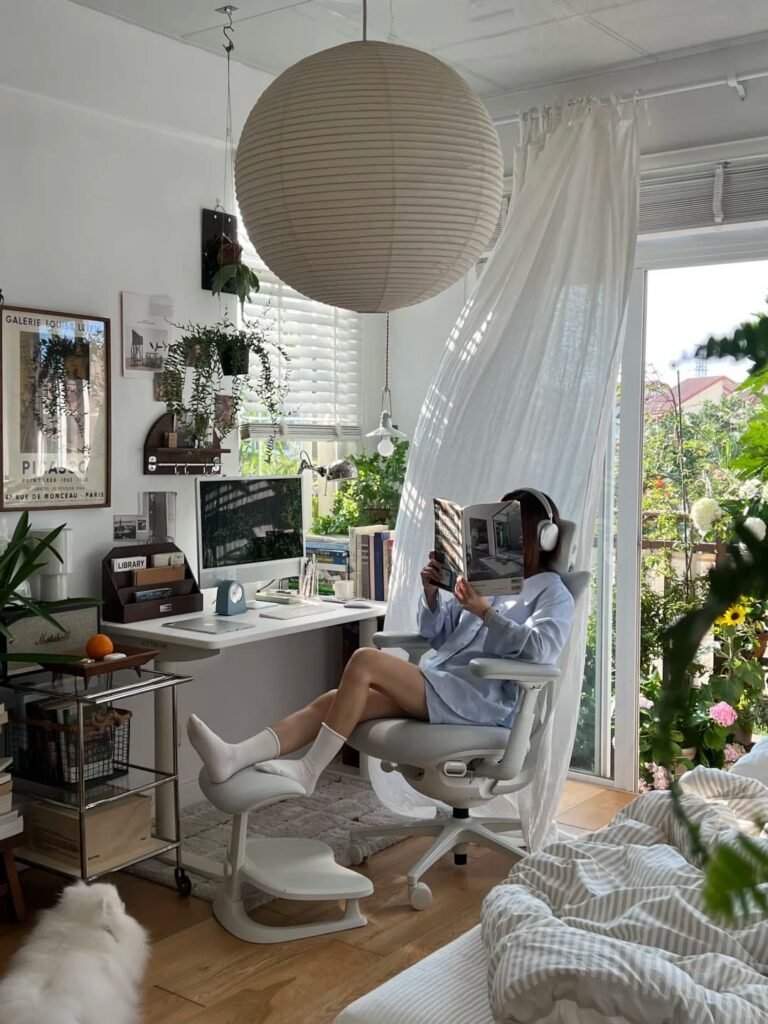
Creating a home office can be daunting, but it doesn’t have to involve a big renovation. We all know that feeling: mid-afternoon on a Wednesday, and the mental noise is hard to shake off. Your water bottle is tangled in charging cables, your chair has become uncomfortable, and your focus is fading.
We spend so many hours at our desks, often more than in our own beds, yet these spaces are frequently neglected. Whether you have a folding table shoved into a corner or a “temporary” setup that’s lasted for years, it’s no surprise that concentrating feels like an uphill battle. You’re not alone in this; Finding a workspace that really supports you is worth pursuing.
rednote / @iiiiisgua
Why Your Workspace Matters
The best home office ideas aren’t about replicating a sterile Instagram grid. There are shifts in light, texture, placement, and ritual that signal to your brain: you can settle in here. You can think here.
To help you reclaim your focus, we’ve gathered 23 actionable tips grouped into four clear intentions:
- Quick Wins: Changes you can make in sixty seconds.
- Weekend Projects: Small shifts that take a Saturday afternoon.
- Ergonomic Fixes: Adjustments to help you breathe deeper and work longer.
- Atmospheric Tweaks: Using sensory details to turn down the “noise.”
Scan through to find what your space is actually asking for, and move toward a workspace that lets you breathe a little deeper and type a little faster.
Calm Home Office Ideas for a Clutter-Free, Visual Detox Workspace
Home office ideas for a serene workspace usually start with what you remove, not what you add. A truly calm environment isn’t defined by what is on display; it’s defined by what your eyes can rest on. When every surface holds a visual demand, tangled cords, unread mail, or yesterday’s coffee mug, your brain processes each one as a tiny, incomplete task.
These six strategies are designed to clear the “visual decibels” until your room finally exhales.
1. The “One-Touch” Declutter Rule
rednote / @iiiiisgua
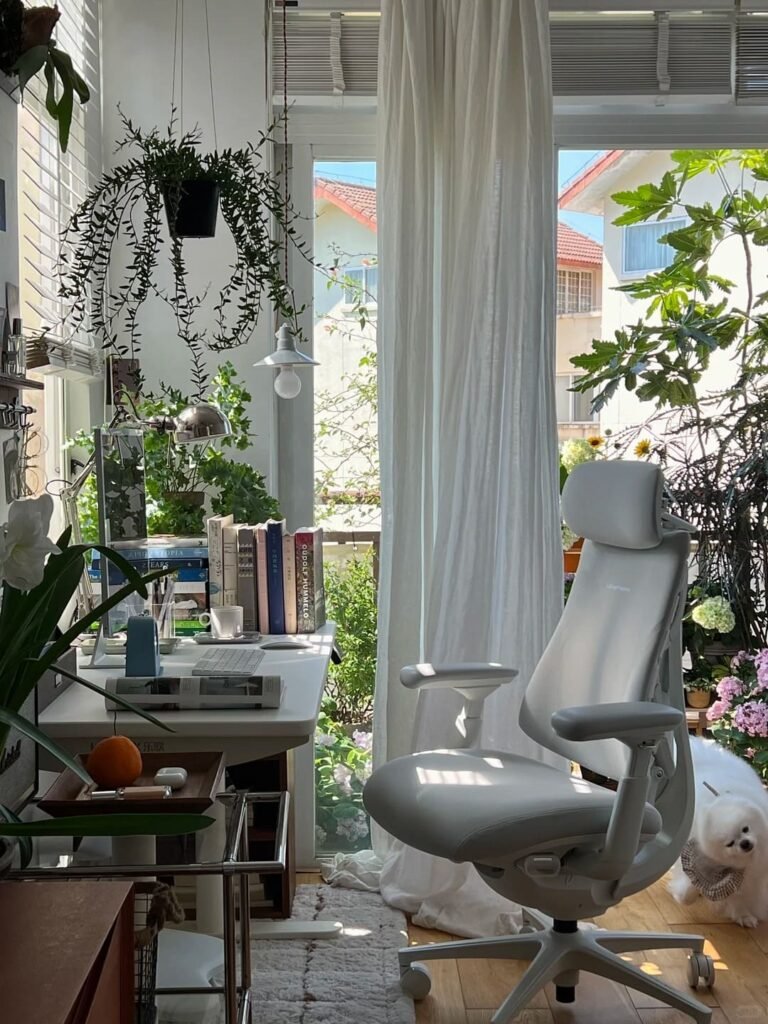
The “one-touch rule” is a productivity staple: handle an item once, decide its fate, and move on. Applying this to your physical workspace prevents the “pile-up” that leads to Friday afternoon burnout.
- Why it works: It eliminates the “decision fatigue” that comes from seeing a messy desk first thing in the morning. Instead of starting your day by cleaning, you start by creating.
- The Action: At the end of every workday, remove everything except your essentials and one intentional object, like a candle, a small vase, or a smooth stone. This is one of those home office ideas that costs zero money but ensures you sit down at a desk that holds nothing but possibilities.
2. Hide the Cords in a Cable Spine
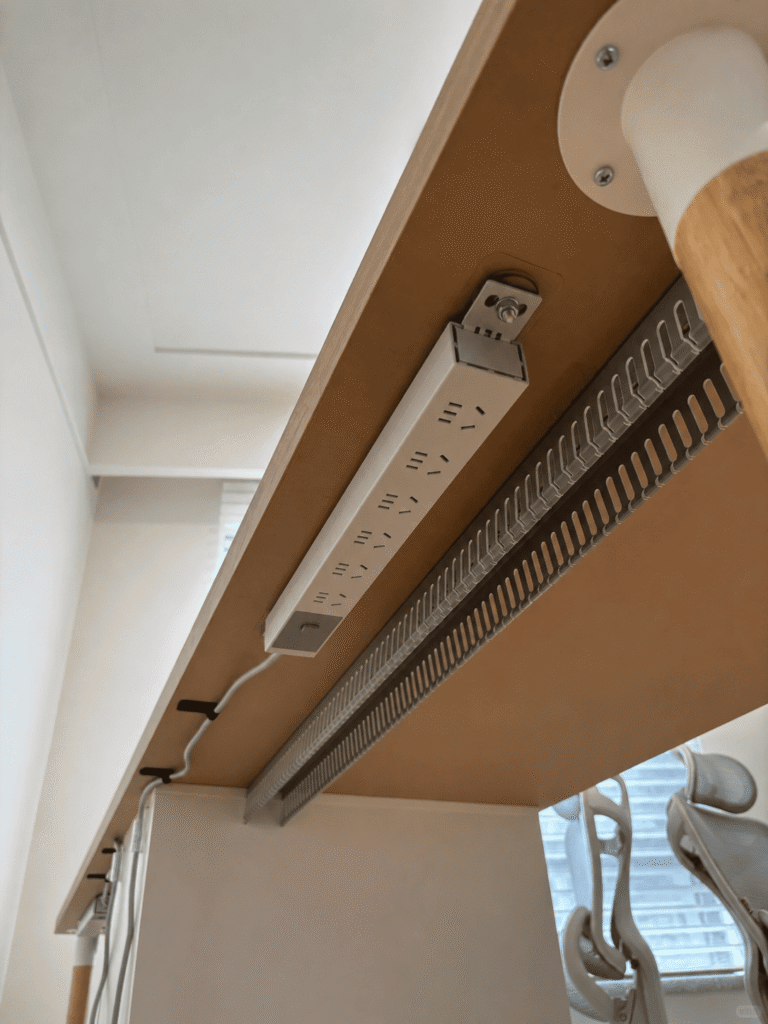
rednote / @程程程程程
Look under your desk. If you see a “technological monster” of tangled wires, you’ve found a major visual stressor. Cords carry a particular kind of chaos; They snake, they knot, and they gather dust.
- Why it works: Your peripheral vision is highly sensitive to “cluttered” patterns. By corralling wires, you stop receiving frantic visual input from below your eye level.
- The Action: Use a cable spine or neoprene tube to group your wires into a single, clean line. Suddenly, the floor feels open, and your feet have room to move without snagging a charger.
3. Go Monochromatic
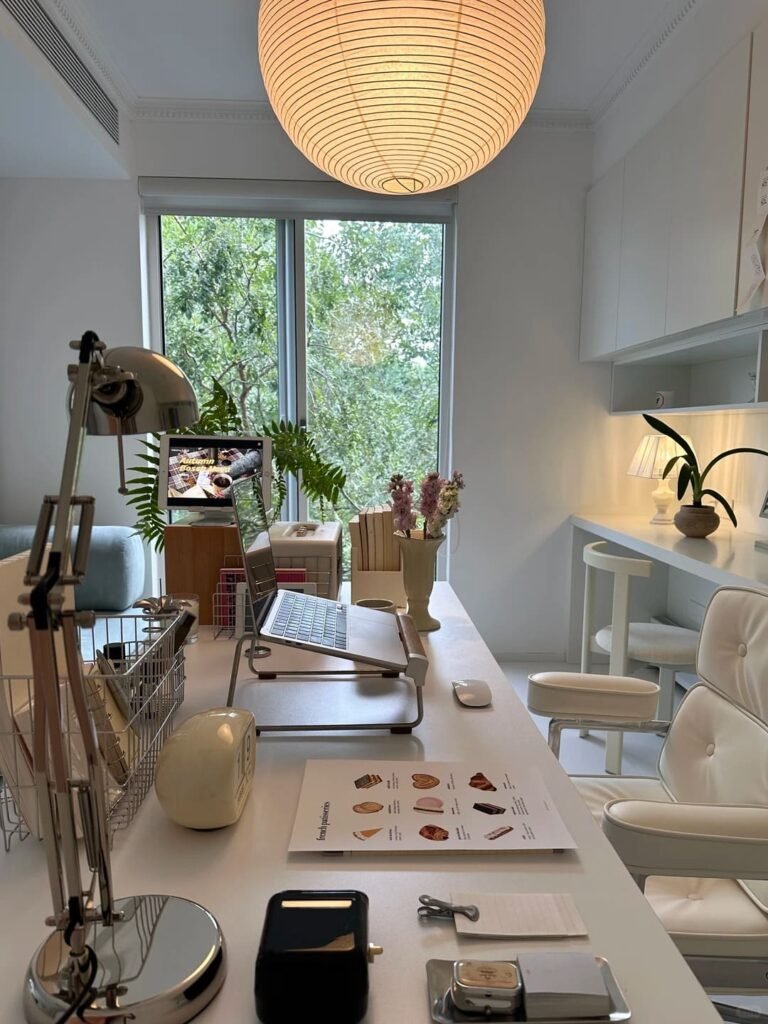
rednote / @MooPear_moonri
The brain registers high color contrast as activity. To keep things calm, you don’t need a boring room; you just need a room that “agrees” with itself.
- Why it works: A unified color story reduces the “cognitive load” required to process your environment. When your tools and decor share a palette, they blend into the background.
- The Action: Pick two base colors and one accent for your immediate sightline (desk, lamp, mug, notebooks). Among home office ideas for focus, this one creates a “visual silence” that allows your thoughts to take center stage.
4. Back to the Wall, Face the Door
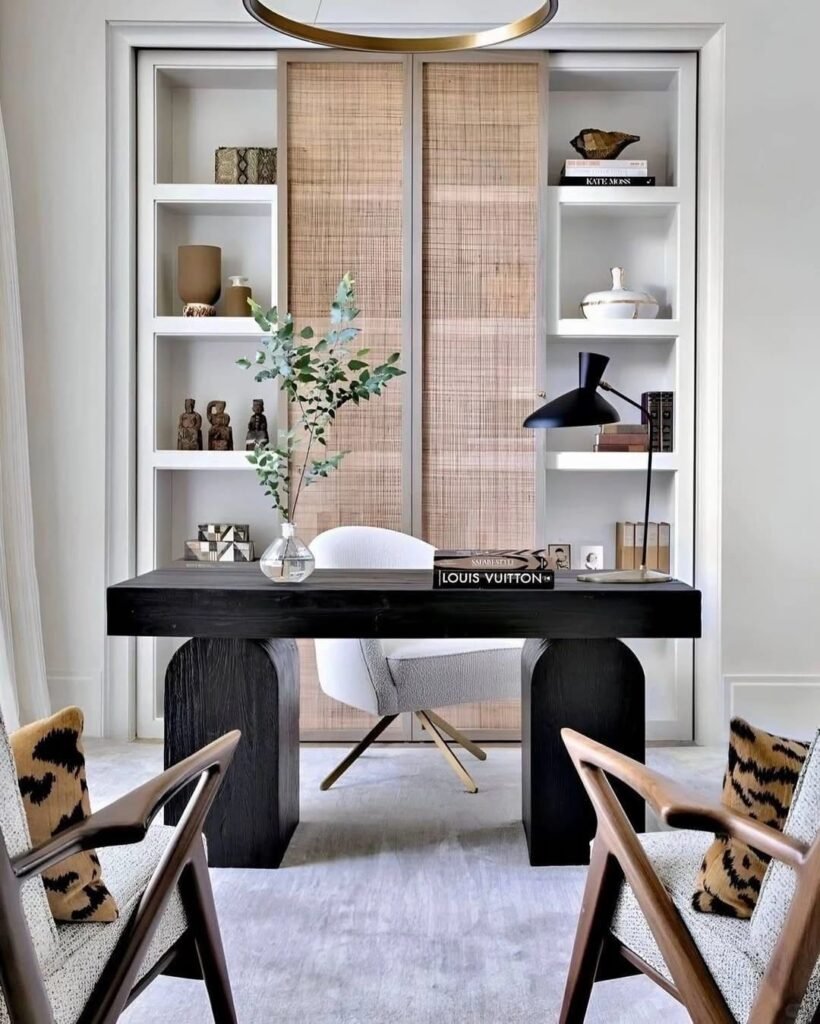
rednote / @MR Songno
In Feng Shui, sitting with your back to the door keeps your nervous system on “low alert” because you can’t see what’s approaching. This is an ancient survival instinct that still applies to modern deadlines.
- Why it works: Known as the “Command Position,” this layout provides a sense of security and authority over the room, letting your subconscious relax.
- The Action: Position your desk so you have a solid wall behind you and a clear view of the entrance. If the layout is fixed, place a small, stylish mirror on your monitor to reflect the space behind you.
5. Create a Floor-Lamp-Only Zone
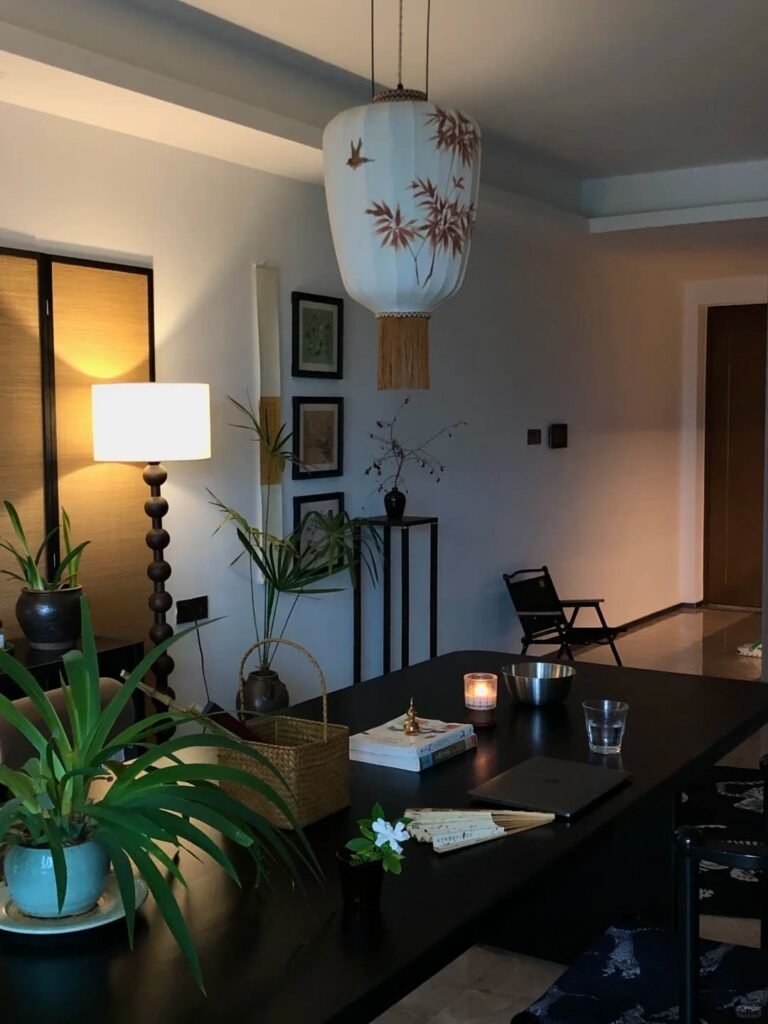
rednote / @Andrew’s desk
Overhead lighting is often flat, institutional, and harsh. It reminds the body of classrooms or waiting rooms, places where you are often stressed or bored.
- Why it works: Soft, layered lighting mimics the natural rhythm of the day. It creates a “cocoon” effect that helps you settle into deep work.
- The Action: Swap the ceiling switch for a warm-toned floor lamp or a soft wall sconce. Among lighting-based home office ideas, this is the one you’ll feel in your body before you notice it with your eyes.
6. Swap Bookcases for Floating Shelves
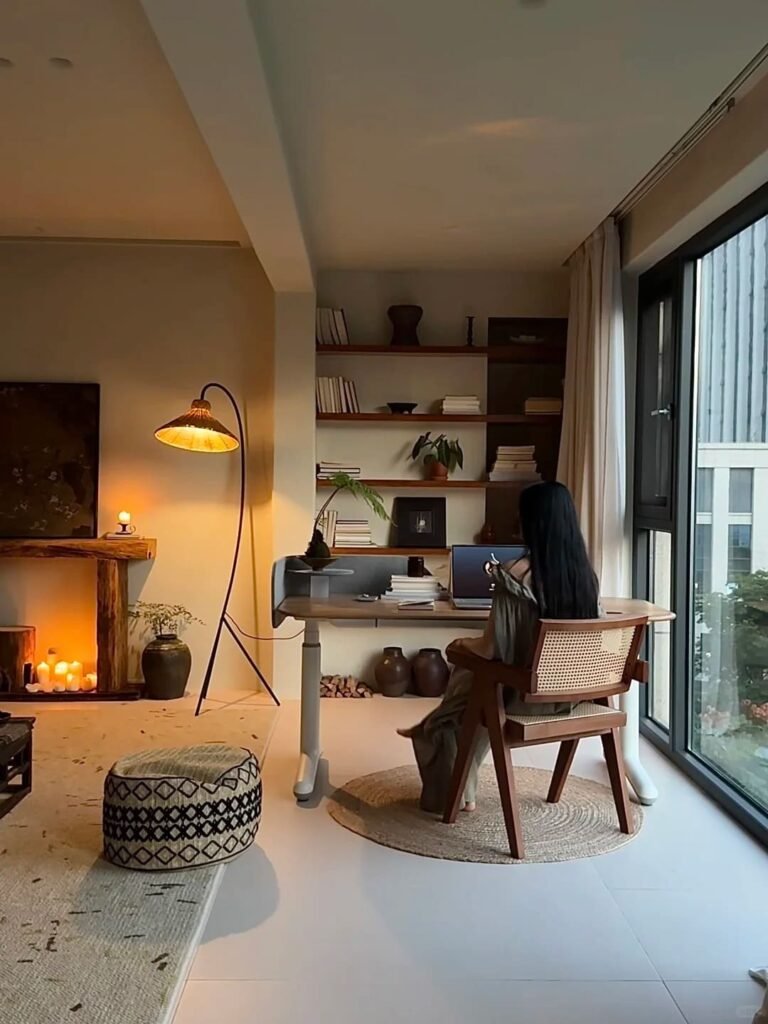
rednote / @Wu Mei’er
A packed bookcase is a beautiful thing, but in a workspace, it can become distracting. Floating shelves, however, force a sense of curation and intentionality.
- Why it works: The “negative space” (the empty wall) around a floating shelf acts as a visual buffer. It allows the eye to land on something beautiful and then return to work without getting “stuck” in clutter.
- The Action: Replace a heavy cabinet with one or two floating shelves. Place just three to five items, a trailing plant, a single print, or a ceramic object, to let the room breathe.
Focused Workspace Ideas to Sharpen Your Concentration
A space can be calm without being productive, and productive without being calm. The goal is both. These next home office ideas are about engineering your environment for the specific kind of attention your work requires, deep, sustained, and mercifully uninterrupted.
This is where ergonomics meets psychology to help you enter a “flow state” faster and stay there longer.
7. The “Sunset” Screen Setting
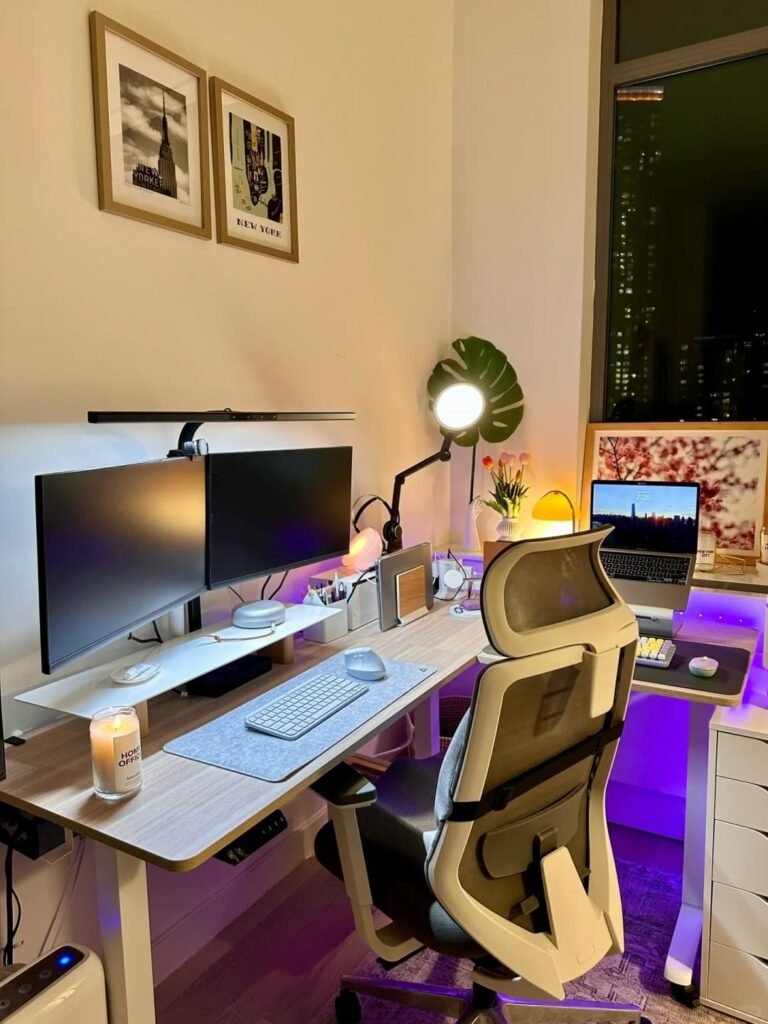
rednote / @It’s Ximu.
Your devices likely have a setting that automatically shifts the screen’s color temperature from cool blue to warm amber. A focused workspace respects the arc of your natural energy over an eight-hour day.
- Why it works: Cool light signals urgency and alertness, which is great for 9 AM. However, by mid-afternoon, that same light can become a source of eye strain and anxiety. Shifting to warmer tones works with your circadian biology instead of fighting it.
- The Action: Set your “Night Shift” or “Blue Light Filter” to begin a subtle shift by 2 PM. When your screen mirrors the sun’s path, it signals to your brain that the day has a shape, helping you transition toward completion.
8. A Dedicated Focus Throw
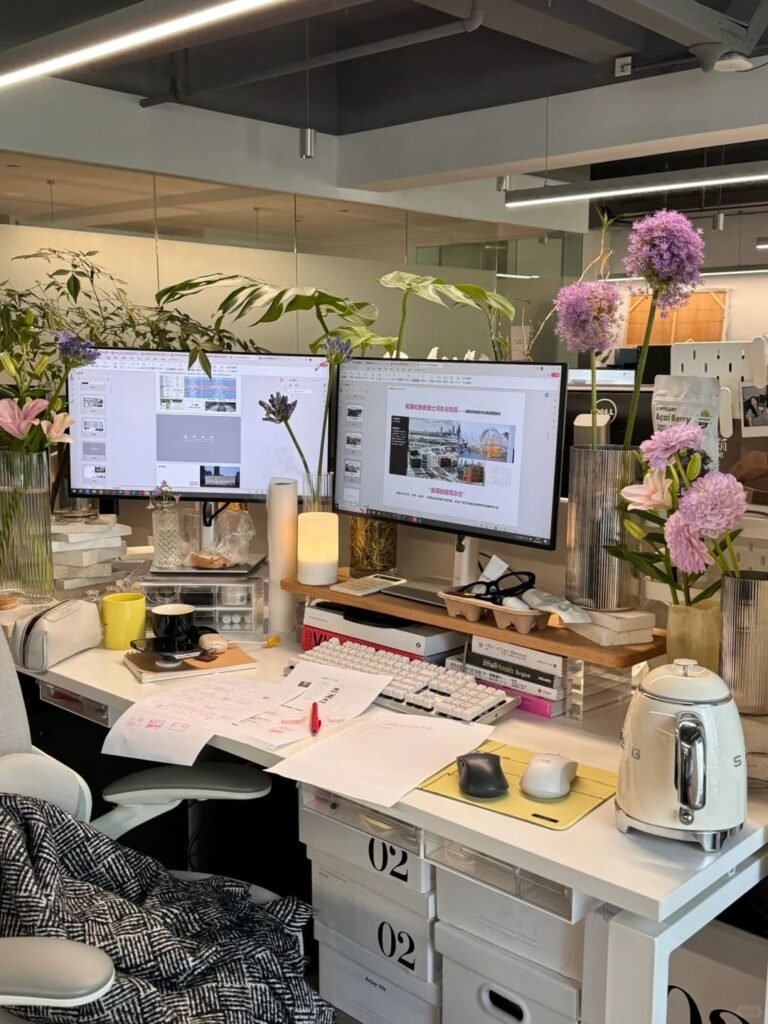
rednote / @Kelly Yao Dali~
This is a behavioral trick disguised as a cozy decor choice. Drape a specific blanket, throw, or textured shawl over the back of your office chair to act as a “work signal.”
- Why it works: The weight of a throw on your lap provides a tactile “anchor” to your task. Furthermore, it serves as a visual boundary for anyone else in the house, a sign that you are “in the zone” and shouldn’t be interrupted.
- The Action: Choose a specific texture you love. When you start a deep work session, put the throw on your lap. When you come up for air or finish the task, fold it back. Among home office ideas for shared spaces, this creates a “door” where none exists.
9. Acoustic Panel Art
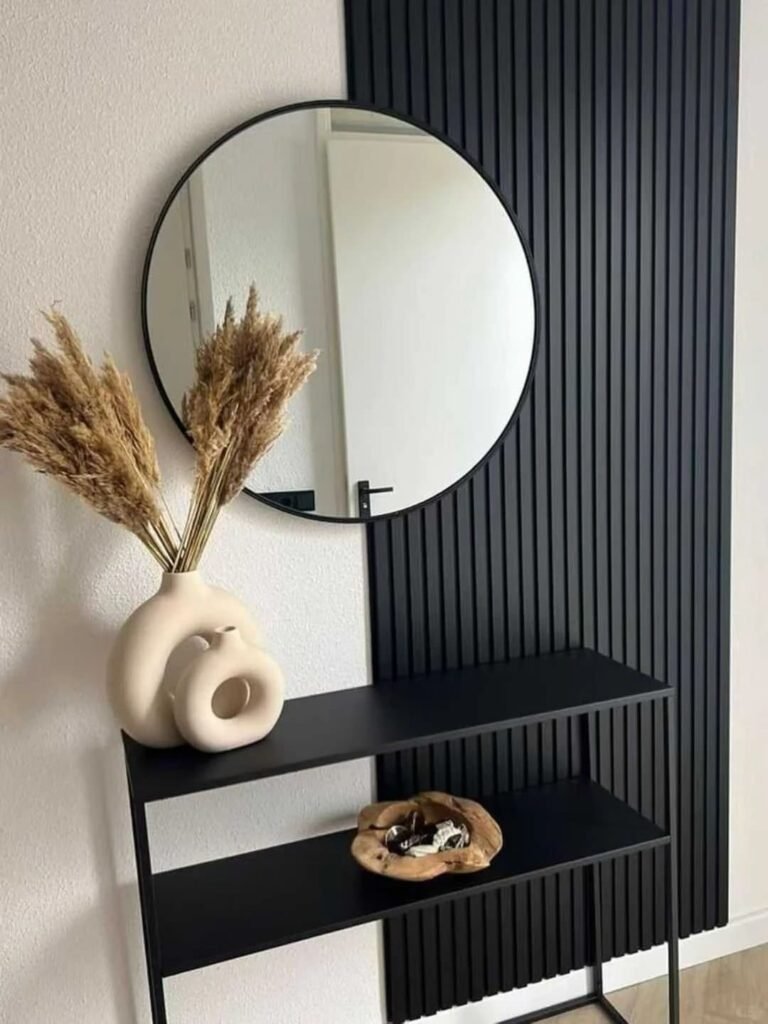
rednote / @Da Yin Acoustics – Rebecca
If your home office shares a wall with a kitchen or living room, noise is the invisible enemy of focus. Modern acoustic panels now double as high-end wall decor.
- Why it works: Sound-absorbing panels reduce the “echo” of household noise and improve your audio quality on video calls. By lowering the auditory “noise floor,” your brain doesn’t have to work as hard to filter out distractions.
- The Action: Hang a fabric-wrapped or printed acoustic panel directly behind your monitor or on the wall facing the loudest part of the house. It’s one of the few home office ideas that solves a functional problem with an artistic solution.
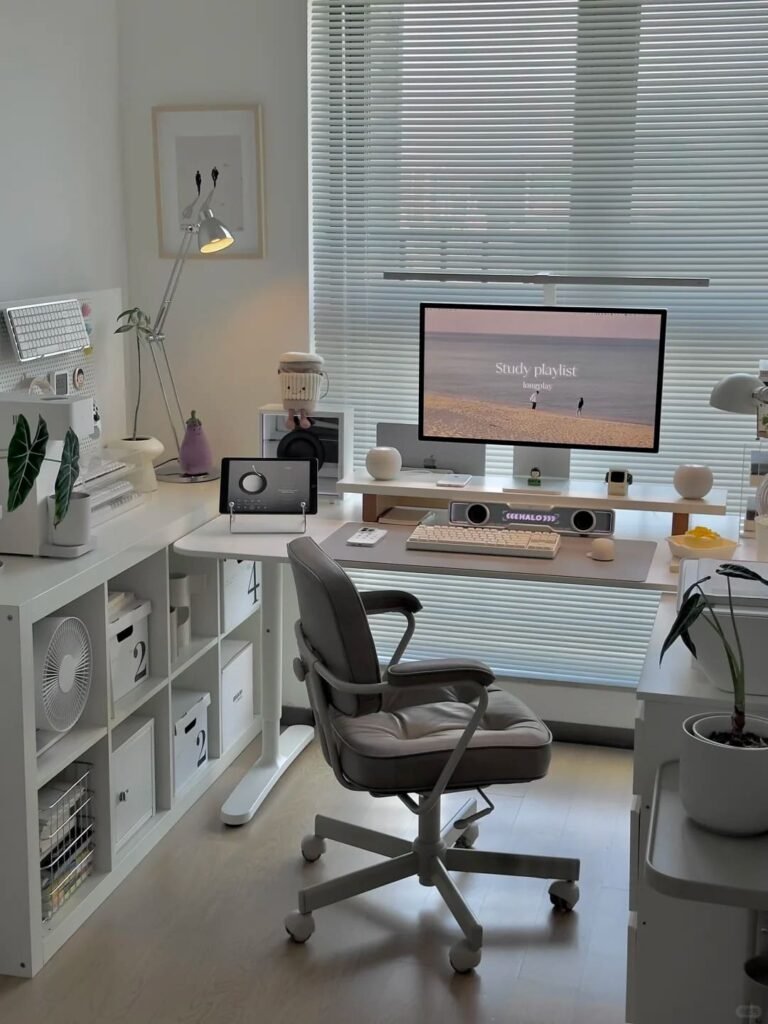
10. A Sidecar Desk for Analog Tasks
rednote / @Chenfeng
Your main desk holds your digital life, but your brain often needs an analog reset. Give your physical notebooks and pens their own tiny, dedicated surface.
- Why it works: Separating “screen work” from “hand work” prevents the mental chaos that occurs when everything blends. When you reach for a notebook on a separate surface, it acts as a physical “reset button” for your focus.
- The Action: Place a small side table, narrow console, or even a sturdy wooden stool to your left or right. Use it exclusively for your physical to-do list, your coffee, and your notebook, keeping your main desk clear for your computer.
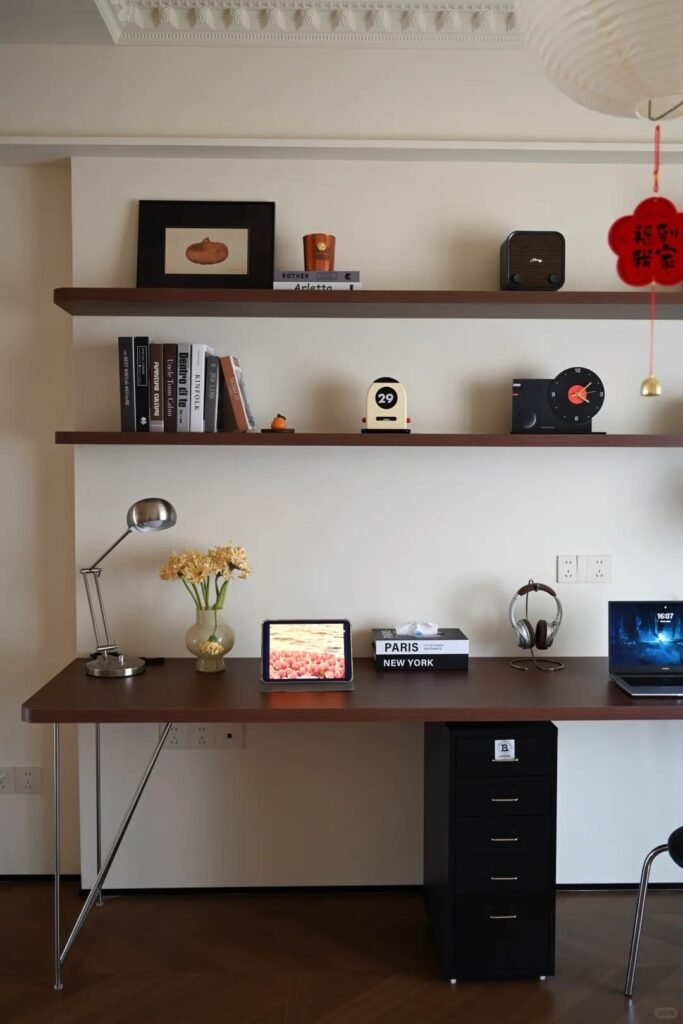
11. A Statement Analog Clock
rednote / @Two Fish Helly
When time lives only in the corner of your monitor, it becomes a digital abstraction that can lead to “time blindness” or mounting anxiety.
- Why it works: An analog clock shows you time as a physical shape; A fraction of an hour or a relationship between the past and the future. It is grounding and helps you pace your work more naturally.
- The Action: Place a large, silent analog clock in your direct sightline.
- Crucial tip: Ensure it is a “silent sweep” model. For a focused workspace, a ticking clock is a distraction you don’t need.
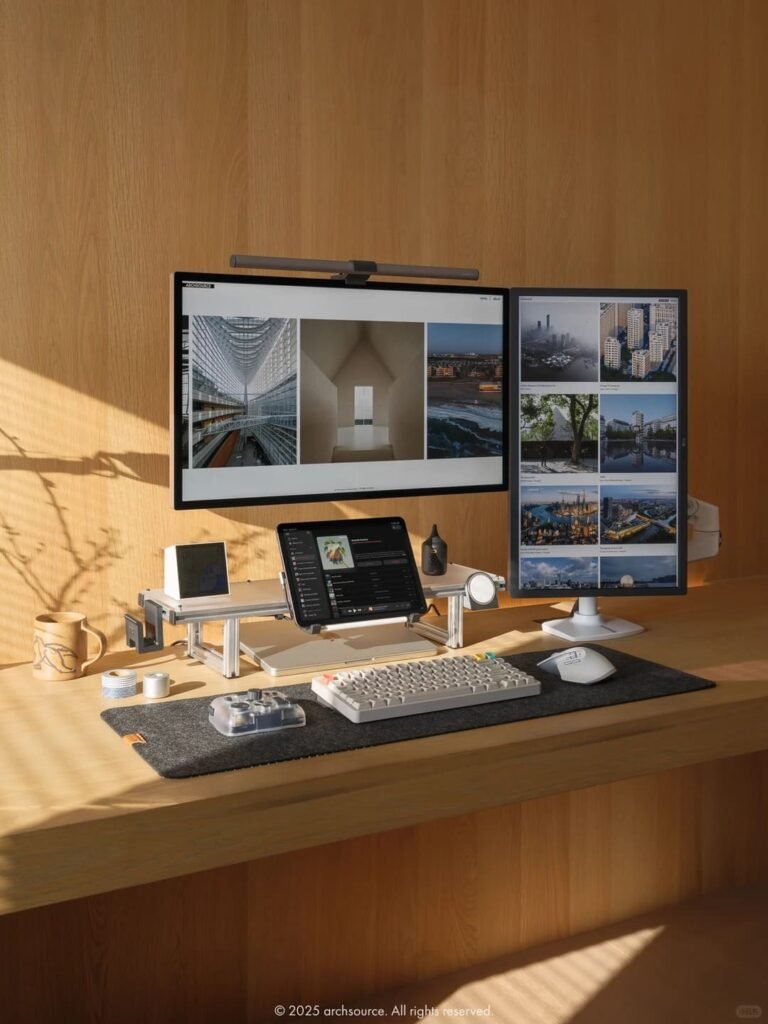
12. A Vertical Monitor Setup
rednote / @Ye Jianyuan
If your work involves deep reading, coding, or long-form writing, rotating a standard monitor 90 degrees is one of the most practical home office ideas for productivity.
- Why it works: A vertical screen reduces the constant need to scroll, which minimizes micro-interruptions to your concentration. It also encourages a more upright posture, reducing the “slump” that leads to afternoon fatigue.
- The Action: Check if your monitor stand allows for a 90-degree rotation (or invest in an inexpensive monitor arm). This setup is a physical promise to your brain that long-form, deep thinking is welcome here.
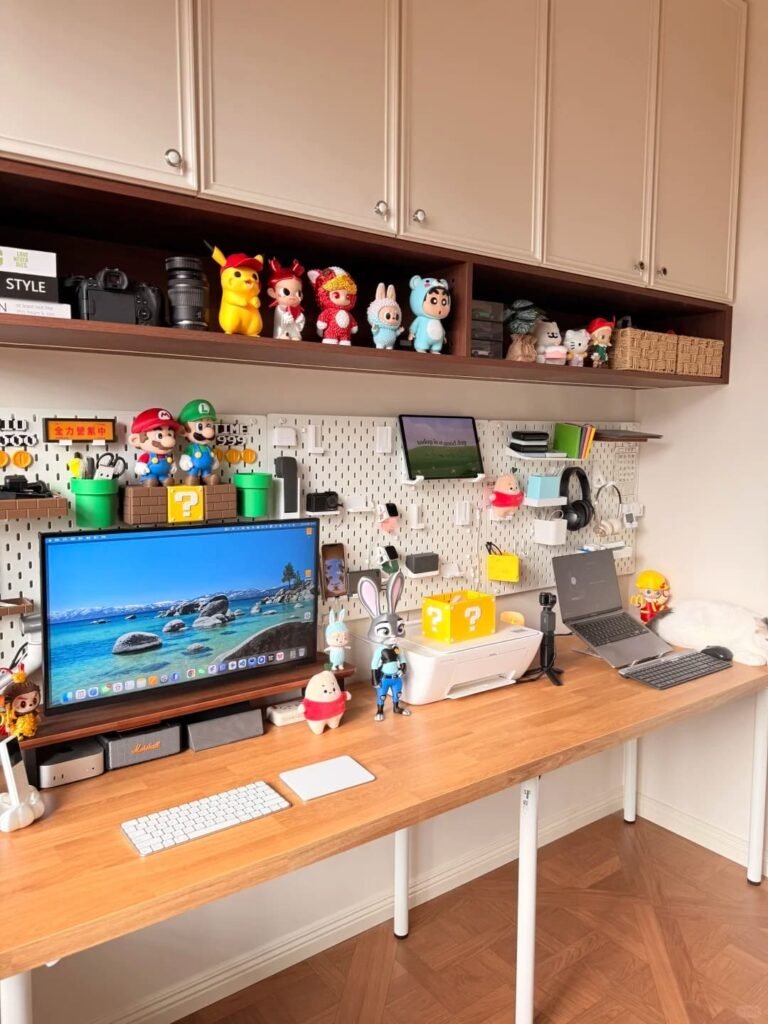
13. A Curated Pegboard
rednote / @小猪咪爱罐罐(软装中)
Pegboards are iconic for organization, but they only work if they stay curated. A cluttered board is just a “wall-mounted storage crisis.”
- Why it works: By putting only your current tools at eye level and leaving plenty of “negative space” around them, the board looks like a gallery of intention. This visual quite supports a calm, focused mind.
- The Action: Clear your pegboard and put back only the 4–5 items you use every single day. Add one small plant or a single piece of inspiration, and leave the rest of the hooks empty.
Effortlessly Stylish Home Office Design Ideas
Now we arrive at the part that makes the calm and focus feel like you. These aren’t decorative afterthoughts; they’re elements where aesthetics and utility fuse so seamlessly you can’t tell where one ends and the other begins. The best home office ideas never announce themselves; they make you want to stay in the room a little longer.
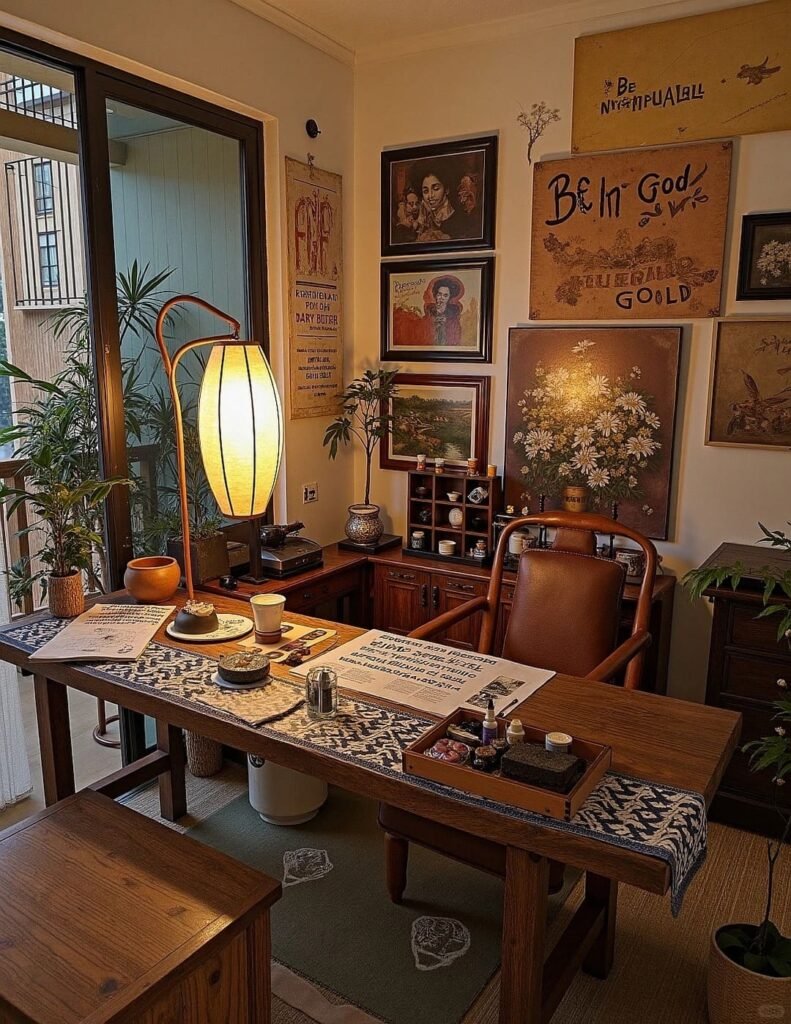
14. Vintage Art as a Zoom Backdrop
rednote / @Lena Müller
Every video call reveals a bit of your world. A blank wall feels sterile, while a generic print can feel impersonal. A vintage piece of art adds an immediate layer of soul to your workspace.
- Why it works: Something with actual texture and a bit of wear on the frame reads as warm and cultivated on camera. It provides a “window” into a slower, more unhurried world, grounding you during high-stress meetings.
- The Action: Source a vintage landscape painting from a thrift store or online marketplace. Position it so it fills the frame behind your head, providing an intriguing backdrop without being a distraction.
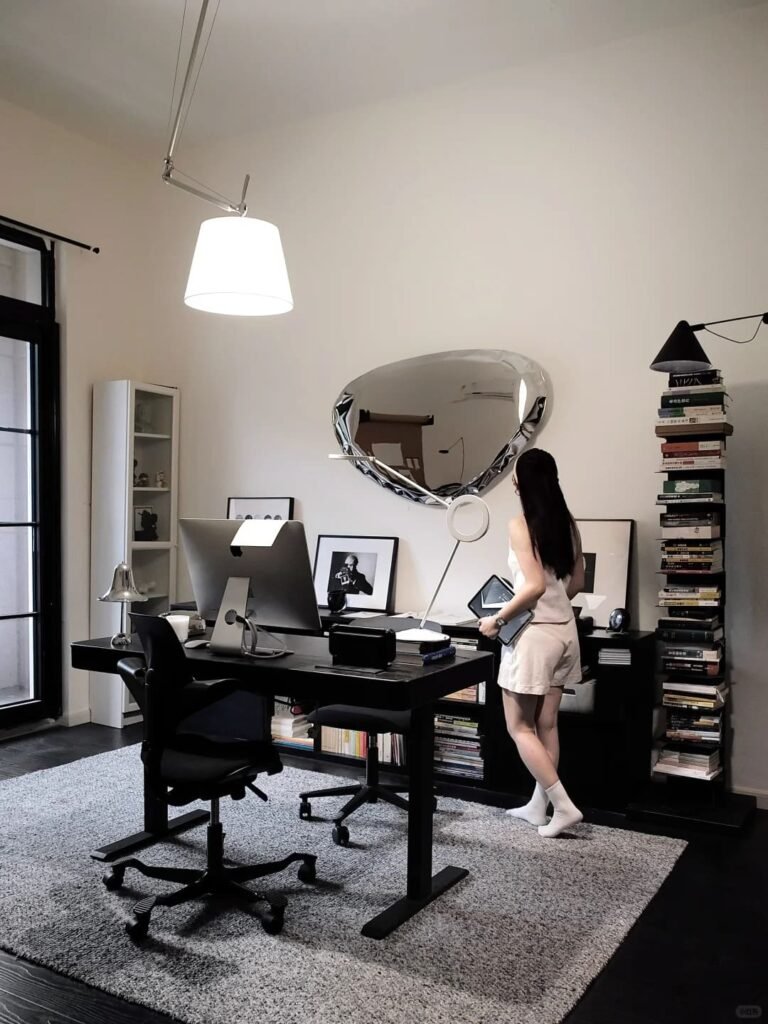
15. A Designer Desk Mat (Leather or Felt)
rednote / @Dordor Lee
A desk mat is the unsung hero of home office ideas that bridges form and function. It protects your desk, but more importantly, it defines your territory.
- Why it works: A large mat in a muted tone (like camel, charcoal, or moss) creates a visual boundary that signals to your brain: within this rectangle, work happens. It also eliminates the chill of a bare desk, and warm forearms lead to warmer focus.
- The Action: Choose a high-quality leather or felt mat. It’s a small investment that instantly elevates the “finished” look of your desk while softening the sound of your typing.
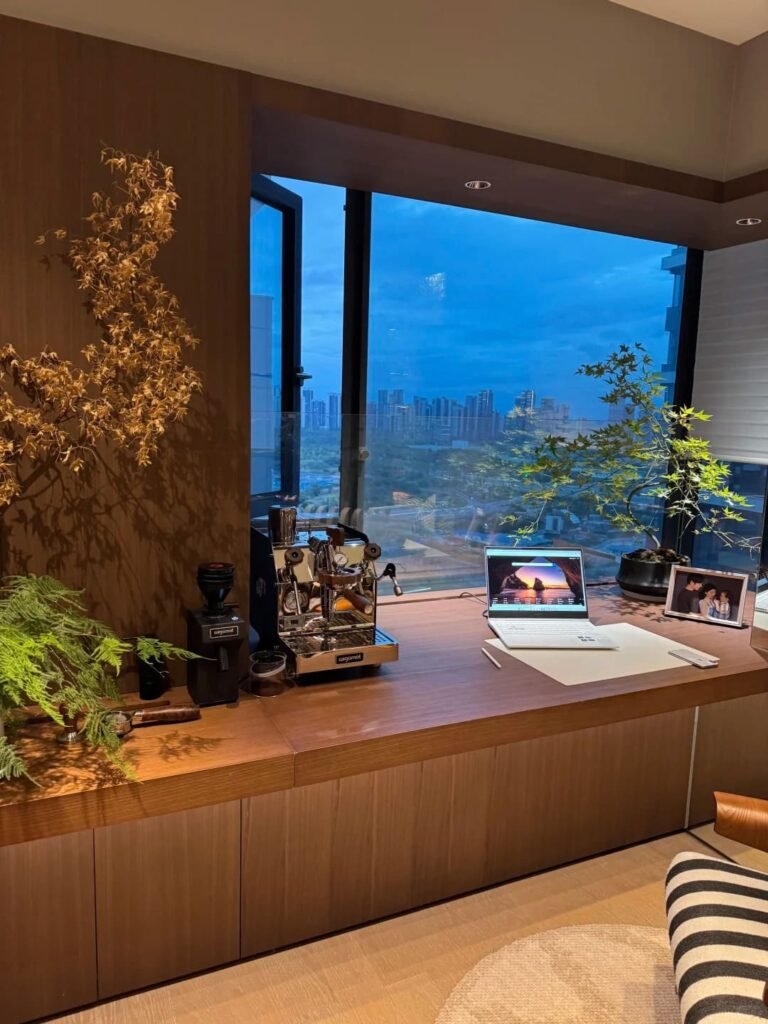
16. A Single, Dramatic Branch in a Vase
rednote / @二宝baba爱分享
Fresh flowers are lovely but high-maintenance. For a stylish home office design that endures past Tuesday, a sculptural branch is the superior choice.
- Why it works: Elements like eucalyptus or curly willow deliver an organic presence without the drama of wilting petals or pollen. It introduces nature into your office in a way that feels architectural and permanent.
- The Action: Find a tall, simple ceramic vase and place a single dried magnolia stem or branch inside. Set it on a side surface where it can break the vertical line of the wall and let the room breathe.
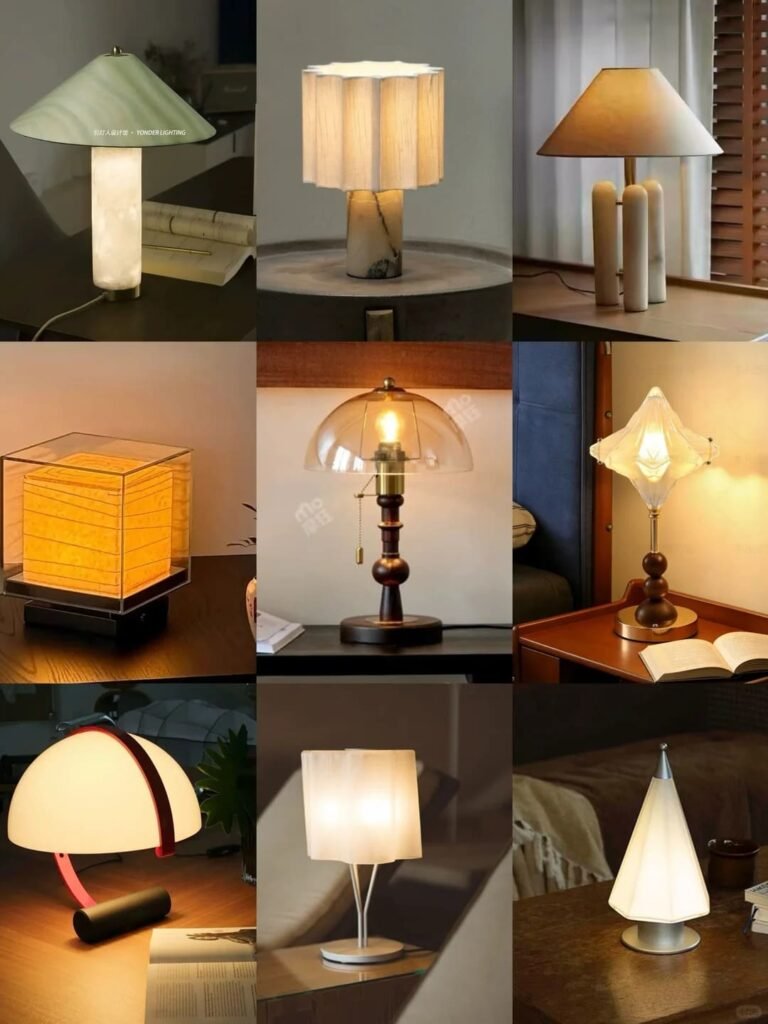
17. A Sculptural Task Lamp
rednote / @Visual trap
A task lamp has one job: illuminate your work. However, there’s no reason it can’t moonlight as a piece of sculpture when the bulb is off.
- Why it works: When a lamp has an interesting silhouette, like a brass articulated arm or a matte ceramic dome, it reads as an intentional design object rather than just a forgotten appliance.
- The Action: Look for a lamp with a unique form that curves over your monitor. When it’s on, it pools light exactly where you need it; when it’s off, it anchors your desk with a sense of style.
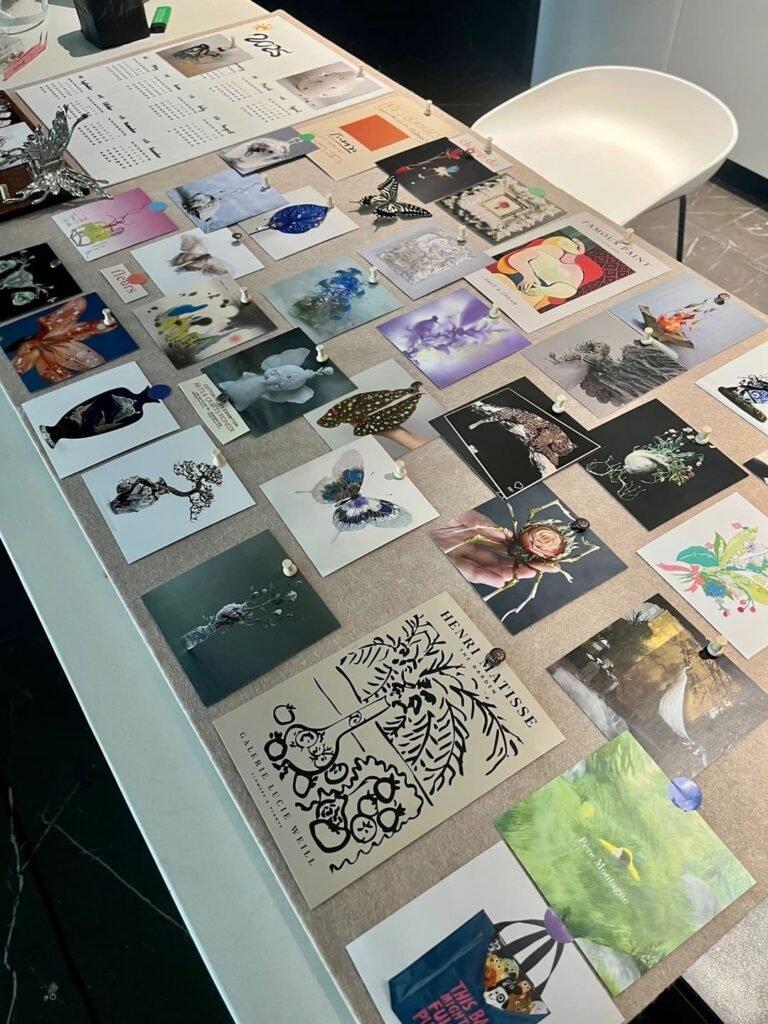
18. An Embroidered or Linen Pinboard
rednote / @Wanming
The standard yellowing corkboard is functionally useful but often “aesthetically tragic.” Replacing it with a textile-wrapped version changes the entire visual weight of your wall.
- Why it works: Linen or canvas introduces a soft, organic texture to a room filled with hard tech. It turns your notes and inspirations into a curated gallery rather than a messy pile.
- The Action: Use a staple gun to wrap a basic pinboard in a neutral linen or embroidered fabric. Use brass pins or wooden clips to attach your reminders, making even your to-do list look like a piece of art.
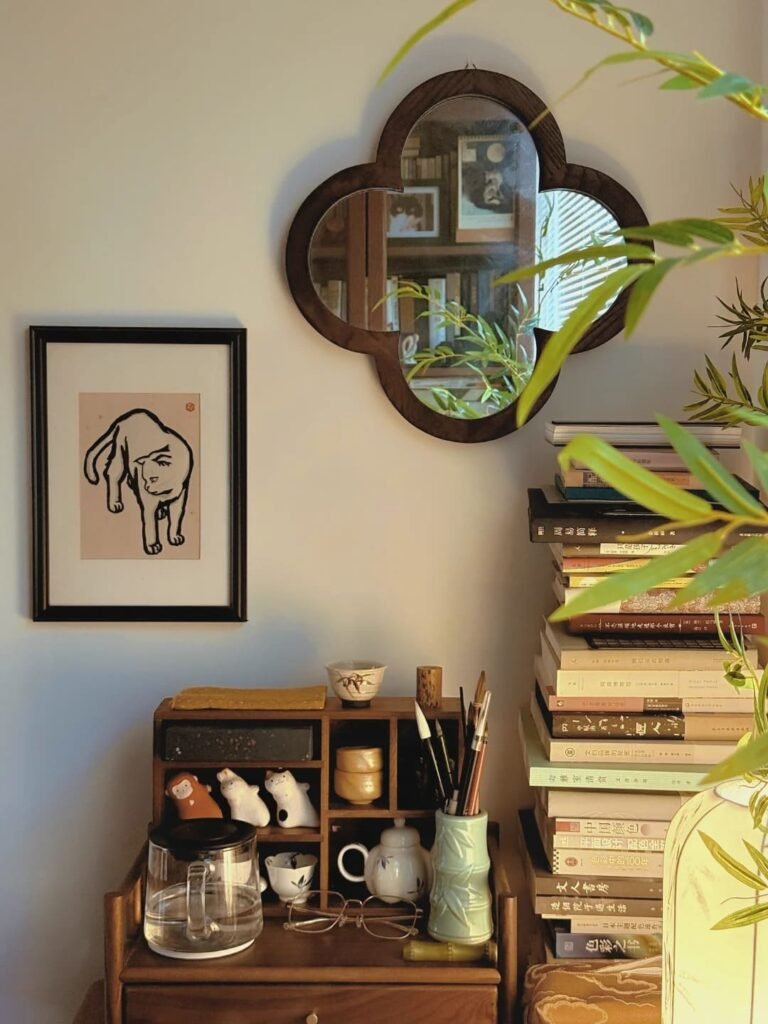
19. Swap Plastic for Ceramic, Wood, or Glass
rednote / @Jie Sang
Plastic objects often read as temporary and visually “light.” Swapping them for natural materials adds a sense of permanence and dignity to your daily routine.
- Why it works: Materials like stone, wood, and glass have weight and temperature. Touching a heavy ceramic mug for your pens or a wooden tray for your notes provides a tactile satisfaction that plastic simply can’t match.
- The Action: Identify every plastic tray or pen cup on your desk. Replace them with one or two high-quality pieces made of wood or ceramic. Your desk will begin to accumulate presence instead of just clutter.
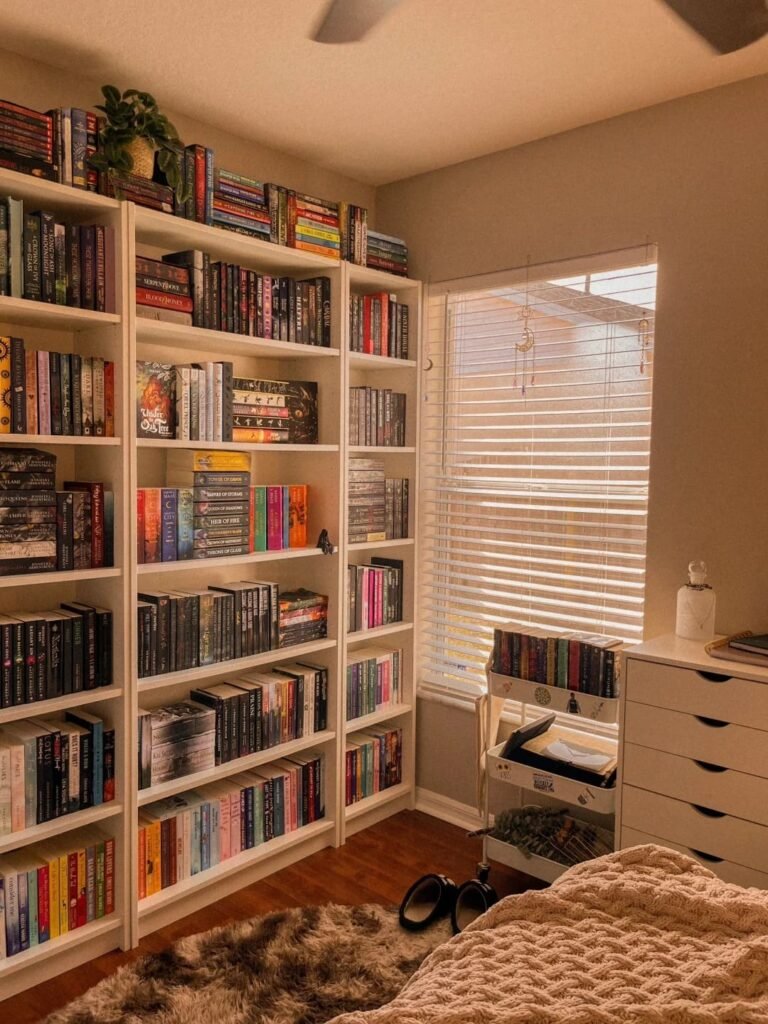
20. A Color-Coded “Library Wall”
rednote / @pleasantreader
If you have a collection of books in your workspace, try organizing them by the color of their spines. While a bit controversial, the visual payoff is undeniable for a focused mind.
- Why it works: Your eye registers a calm, cohesive band of color instead of a jumbled checkerboard of competing titles. This reduces visual “noise,” making the room feel more spacious and orderly.
- The Action: Spend a Saturday afternoon grouping your books by hue. When the spines form a harmonious gradient, they become a visual asset that supports your concentration rather than interrupting it.
Small Home Office Ideas Inspired by Nature
Not everyone has a dedicated room with a door that closes. Many of us work in corners, alcoves, or a narrow slice of the living room where the light happens to fall. But small doesn’t mean powerless, especially when you lean into elements that connect you to the natural world.
These final home office ideas are about anchoring yourself in something alive, even when your square footage is modest.
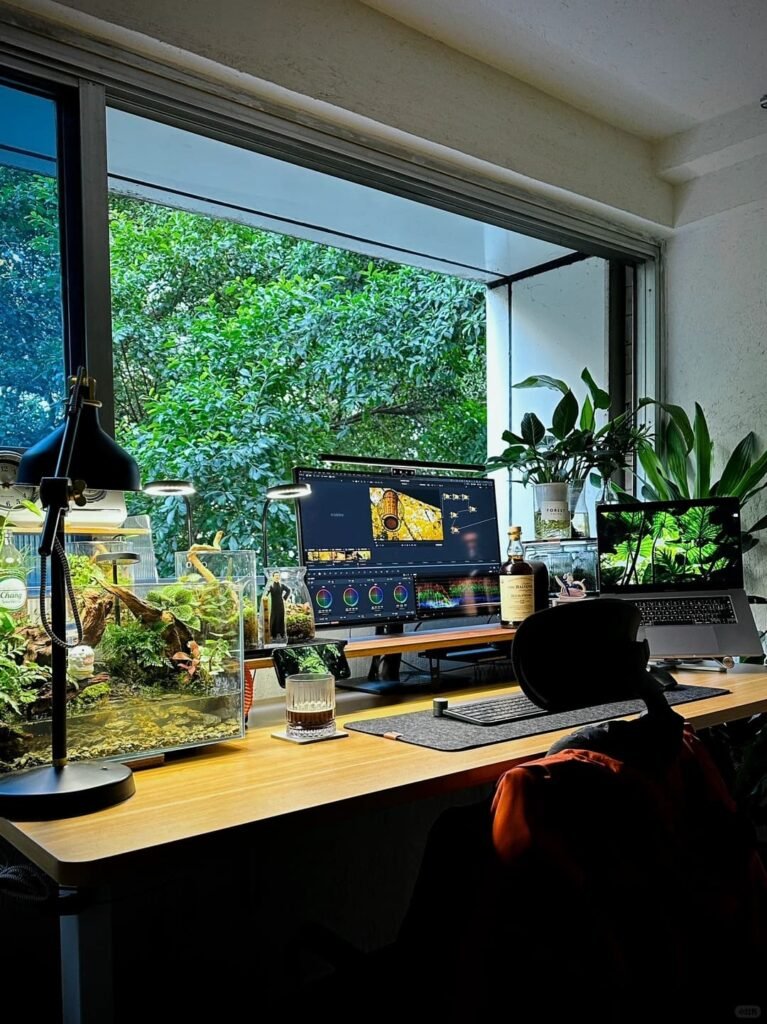
21. A “Screen-Break” Plant
rednote / @Aion2研究局
Every workspace needs a plant placed beyond the monitor, not just beside it. When you look up from your screen, your eyes need a destination that isn’t another digital device or a blank wall.
- Why it works: Looking at something green and living at a distance of six feet or more is a micro-reset for your visual system. It reduces eye fatigue and creates a wordless moment of calm every time you pause.
- The Action: Position a tall plant, like a snake plant, fiddle leaf fig, or rubber tree, on a stand a few feet behind your desk. In the world of small home office ideas, one well-placed floor plant does more for your nervous system than five small succulents scattered randomly.
22. Woven Baskets for Concealed Storage
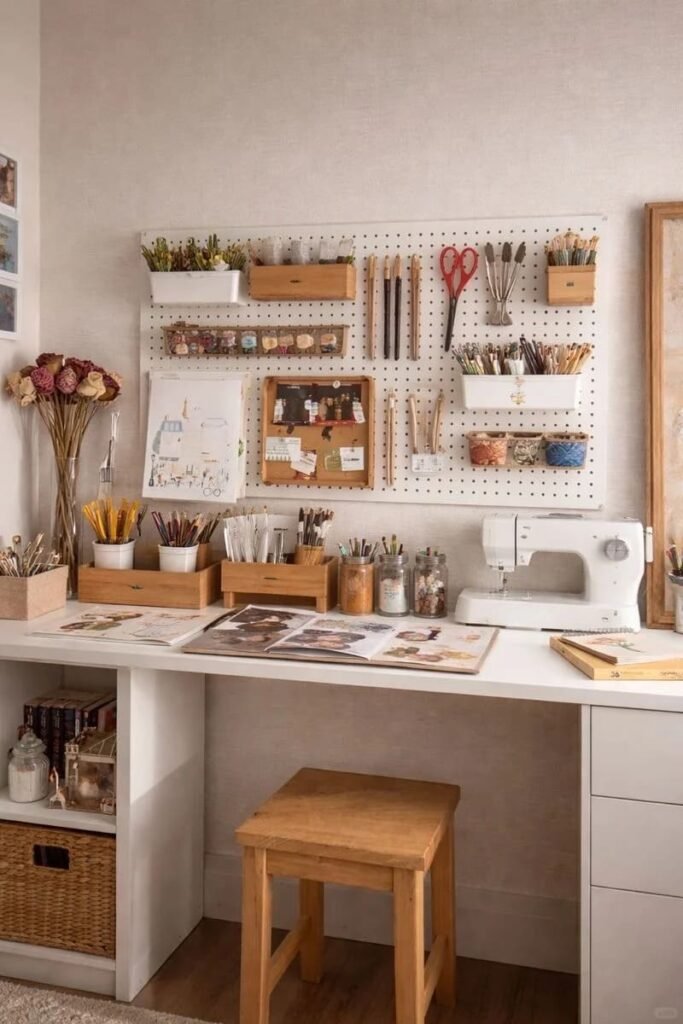
rednote / @Living Simple
Every office accumulates “necessary but unattractive” items like printer paper, spare chargers, and external hard drives. Instead of reaching for plastic bins, look toward organic textures.
- Why it works: Materials like seagrass, rattan, or water hyacinth soften the room both acoustically and visually. Your storage becomes an intentional part of the room’s decor rather than a “problem” you’re trying to hide.
- The Action: Tuck two or three matching woven baskets under your desk or on a lower shelf. This keeps your backup cables and notebooks out of sight while adding a layer of warmth to the room.
23. A Desk-Facing Window (or Strategic Mirror)
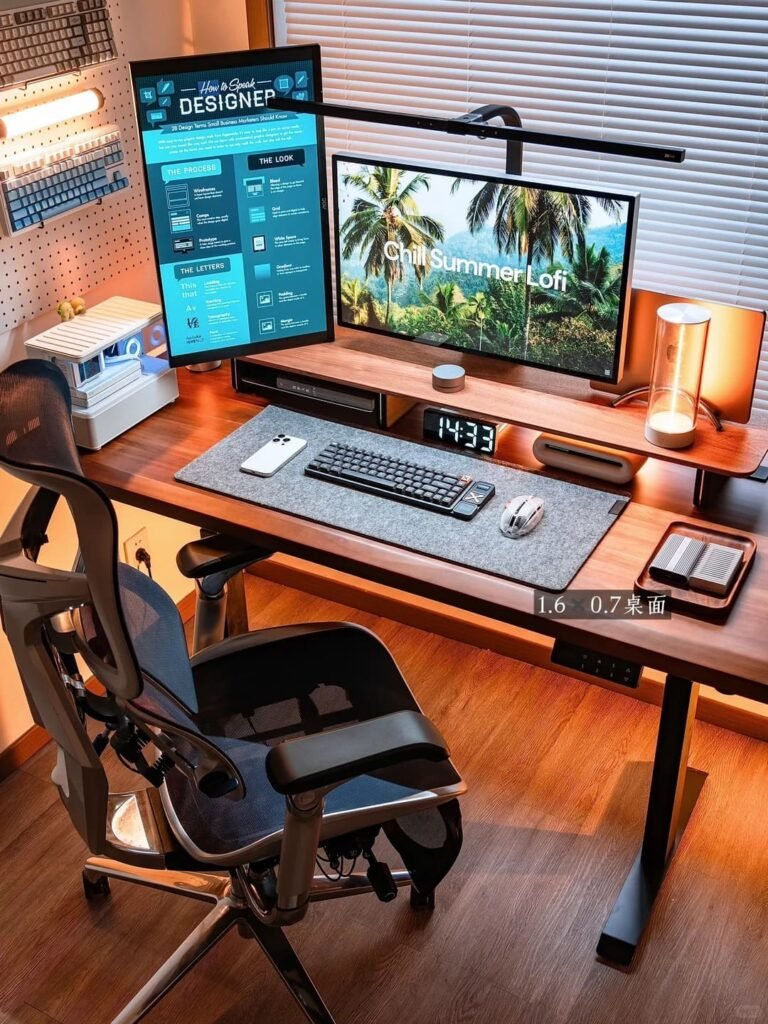
rednote / @爱拍照的书桌
Small spaces benefit enormously from any trick that suggests the room continues beyond its actual boundaries. Distance is rest for a mind that has been focused on a screen all day.
- Why it works: If your eyes have somewhere far to travel when they leave the screen, even if it’s just a slice of sky or a brick wall with changing light, it prevents the “boxed-in” feeling that leads to midday fatigue.
- The Action: If possible, position your desk to face a window. If your layout is fixed, hang a mirror on the adjacent wall at an angle that reflects the natural light source. Among the best home office ideas for small footprints, this creates an illusion of depth and bounces light into the darker corners of your workspace.
Crafting Your Perfect Workspace
Your workspace is never neutral. It is either working for you, quietly holding your focus and softening your stress, or it is working against you in ways so subtle you’ve stopped noticing. The static hum of a messy desk, the tangled cords, and the chair that aches by 4 PM all add up to a heavy cognitive load.
The beauty of these 23 home office ideas is that they don’t require a blank-slate renovation or an intimidating budget. Instead, they invite small, intentional choices:
- The atmosphere: A floor lamp switched on instead of an overhead light.
- The Organic: A sculptural branch in a vase or a “screen break” plant.
- The Orderly: Cords gathered into a single spine and a “one-touch” declutter rule.
Each shift might feel modest on its own. However, when compounded across weeks and months, they create a room that supports you functionally and emotionally.
Your Next Step
Don’t feel pressured to implement all 23 at once. Pick just three ideas from this list: the ones that felt like a small “exhale” when you read them. Start there, and let the rest of your home office transformation follow when you’re ready.
FAQ
Home Office Design